- Research-Grade Peptides · 18+ Only · For Laboratory Use Only

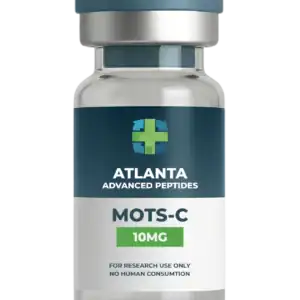

MOTS-c 10mg
-
Unit Size: 10mg
-
Form: Lyophilized powder
-
Storage: Store dry at 2°C–8°C. After reconstitution, refrigerate between 2°C–8°C and use within 10–14 days.
$59.99
Description
What is MOTS-c?
MOTS-c — short for Mitochondrial Open Reading Frame of the 12S rRNA Type-c — is a peptide with an origin story that genuinely surprised the scientific community when it was published in 2015. Most bioactive peptides are encoded in the nuclear genome. MOTS-c is encoded in the mitochondrial genome — specifically within the 12S ribosomal RNA gene — a location that researchers had not previously associated with functional peptide production. Its discovery by a team led by Dr. Pinchas Cohen at USC changed how scientists think about mitochondrial biology and opened an entirely new category of mitochondrial peptide research that continues to generate significant published investigation today.
What makes MOTS-c peptide research 10mg particularly compelling from a scientific standpoint is where MOTS-c goes after it is produced. Unlike most mitochondrially-associated proteins that stay localised within the organelle, MOTS-c has been documented translocating to the nucleus in laboratory models — where it appears to interact directly with gene expression regulation. A peptide that originates in mitochondria and travels to the nucleus to influence gene transcription is a genuinely unusual biological profile, and it is the primary reason MOTS-c has attracted such rapid and broad scientific interest in the decade since its discovery.
MOTS-c 10mg Compound Specifications
| Specification | Detail |
|---|---|
| Common Name | MOTS-c |
| Full Name | Mitochondrial Open Reading Frame of the 12S rRNA Type-c |
| Sequence | MRWQEMGYIFYPRKLR |
| Amino Acids | 16 |
| Molecular Formula | C₁₀₁H₁₅₈N₃₀O₂₆S |
| Molecular Weight | 2174.6 g/mol |
| Format | 10mg lyophilized powder |
| Purity | ≥ 99% |
| Storage | Store at -20°C, away from light and moisture |
| Reconstitution | Bacteriostatic water recommended |
| Research Use | In-vitro and in-vivo laboratory research only |
MOTS-c and the New Field of Mitochondrial Peptide Research
To put MOTS-c compound research in proper context, it helps to understand what changed in biology when it was discovered. For decades, the mitochondrial genome was considered to encode only 13 proteins — all of them components of the oxidative phosphorylation machinery. The idea that small open reading frames within mitochondrial RNA sequences could produce bioactive peptides was not seriously considered until humanin was identified in the early 2000s, followed by MOTS-c in 2015, and then several others in subsequent years.
This emerging class of compounds — now referred to as mitochondria-derived peptides (MDPs) — represents a fundamentally new category in peptide biology. MOTS-c is the most actively researched MDP in the published literature, and its unusual cellular behaviour — nuclear translocation, AMPK pathway interaction, and apparent sensitivity to metabolic stress — has made it a compelling research tool for laboratories working in metabolic biology, longevity research, and cellular energy homeostasis. The field is still relatively young, which means the published literature is growing rapidly and many questions remain open — exactly the kind of research environment where having access to a high-purity buy MOTS-c 10mg compound matters.
MOTS-c in Scientific Research
Despite MOTS-c being discovered less than a decade ago, the published research literature has expanded significantly across several biological domains. Here is an honest overview of what laboratory investigations have documented.
AMPK Activation and Cellular Energy Regulation Research
The most consistently documented finding in published MOTS-c peptide research 10mg literature involves AMPK (AMP-Activated Protein Kinase) pathway activation. AMPK is often described as the cell’s primary energy sensor — it activates when cellular energy status falls and coordinates a metabolic response to restore energy balance. Published laboratory studies have documented that MOTS-c activates AMPK in muscle cell and adipocyte in-vitro models, with downstream effects on glucose uptake, fatty acid oxidation signalling, and mitochondrial biogenesis pathway regulation. For researchers studying cellular energy homeostasis, MOTS-c represents a research tool with a direct mechanistic connection to the pathway they are investigating.
Nuclear Translocation and Gene Expression Research
The nuclear translocation behaviour of MOTS-c compound is the aspect of its biology that most distinguishes it from other peptide research compounds. Published studies have documented that under conditions of metabolic or oxidative stress in laboratory models, MOTS-c moves from the cytoplasm into the nucleus — where it appears to interact with the antioxidant response element (ARE) and influence the expression of genes involved in stress response, metabolic regulation, and cellular survival pathways. This is not typical peptide behaviour. The ability to study a mitochondrially-encoded peptide acting as what appears to be a retrograde signal between mitochondria and the nucleus gives researchers an unusually direct window into mitochondrial-nuclear communication biology.
Insulin Sensitivity and Glucose Metabolism Research
A significant portion of published mitochondrial peptide research on MOTS-c involves insulin signalling and glucose metabolism. In-vitro and in-vivo laboratory studies have examined how MOTS-c influences insulin sensitivity in muscle and adipose tissue research models, with published data documenting improvements in glucose uptake signalling, GLUT4 transporter expression, and insulin receptor substrate activity in controlled experimental environments. Researchers working in metabolic biology and diabetes research models have referenced MOTS-c consistently in this context, and it is one of the areas where the published literature on this compound has grown most rapidly since its discovery.
Exercise Biology and Skeletal Muscle Research
One of the more distinctive findings in the published MOTS-c literature is its relationship to exercise biology. Published research has documented that MOTS-c levels change in response to physical exertion in animal research models — an observation that prompted laboratory investigation into whether MOTS-c functions as an exercise-mimicking signal in metabolic tissue. In-vitro studies have examined how MOTS-c influences skeletal muscle cell metabolism, mitochondrial biogenesis, and fatigue resistance signalling pathways. This area of buy MOTS-c 10mg research investigation connects mitochondrial peptide biology directly to exercise physiology research in a way that no other compound in our catalog does.
Longevity and Ageing Biology Research
The research group that discovered MOTS-c — led by Dr. Cohen at USC — has published extensively on its potential relevance to ageing biology. Laboratory studies have examined how MOTS-c influences cellular senescence pathways, mitochondrial function in aged tissue models, and lifespan regulation in model organisms under controlled research conditions. Published data has documented declining MOTS-c levels in aged animal models alongside declining physical and metabolic function, which has driven research interest in whether mitochondrially-derived peptides play a role in the biological ageing process. This remains an active and rapidly expanding area of MOTS-c compound research investigation.
Research Disclaimer: All research references above relate exclusively to published scientific literature and controlled laboratory investigations. MOTS-c 10mg supplied by Atlanta Advanced Peptides is for research use only and is not approved for human or veterinary application under any circumstances.
Why the 10mg Format for MOTS-c Research
MOTS-c research is still in relatively early stages compared to compounds like BPC-157 or GHK-Cu with decades of published literature. Many laboratories entering this area are running exploratory protocols — broader study designs with more experimental timepoints and larger sample groups — before narrowing to more targeted investigations. The 10mg format supplied here supports that kind of research scope without requiring frequent reordering mid-study, which can introduce batch variability into experimental results. For any laboratory where consistency across an extended protocol matters, starting with the larger format is the more practical decision.
Ordering MOTS-c 10mg
MOTS-c 10mg ships via USPS Ground Advantage or USPS Priority Mail to research facilities across the USA. Orders are processed Monday through Friday during standard business hours. Full tracking is provided with every shipment and checkout is fully encrypted.
All purchases are made with the explicit understanding that:
- The purchaser is 18 years of age or older
- The compound will be used solely for legitimate in-vitro or in-vivo laboratory research
- The product will not be used for human or veterinary purposes under any circumstances
Reconstitution Guidelines for Research Use
MOTS-c 10mg is supplied as a lyophilized powder and requires reconstitution before use in laboratory protocols. It is compatible with bacteriostatic water as the reconstitution solvent. Inject solvent slowly down the inner wall of the vial without shaking vigorously, store reconstituted compound refrigerated at 2–8°C, and apply standard laboratory PPE and sterile technique throughout all handling steps.
Related Research Compounds
Researchers working with MOTS-c frequently reference these related compounds in their laboratory studies:
- NAD+ 500mg — the most closely related metabolic research companion to MOTS-c, with its own well-documented role in mitochondrial function, SIRT1 signalling, and cellular energy regulation research models
- Tesamorelin 10mg — GHRH analog referenced alongside MOTS-c in metabolic and body composition biology research contexts
- GLP-1 SM 10mg — GLP-1 receptor agonist studied in overlapping metabolic signalling research domains alongside MOTS-c
- Ipamorelin 10mg — GHRP analog referenced in metabolic and body composition research contexts that overlap with MOTS-c investigation
- Bacteriostatic Water 10ml — recommended reconstitution solvent for laboratory use
Research Disclaimer
⚠️ For Laboratory Research Use Only
MOTS-c 10mg supplied by Atlanta Advanced Peptides is intended strictly for in-vitro and in-vivo scientific research conducted by qualified researchers in controlled laboratory environments. This compound is not approved for human consumption, veterinary use, or any clinical application whatsoever. It is not classified as a drug, supplement, food product, or therapeutic agent. All purchasers must be 18 years of age or older. By completing a purchase, the buyer explicitly confirms that this compound will be used solely for legitimate scientific research purposes and in full compliance with all applicable local, state, and federal laws and regulations.
Additional information
| Weight | 0.2 lbs |
|---|---|
| Unit Size | 10mg |
| Form | Lyophilized powder |
| Storage | Store dry at 2°C–8°C. After reconstitution, refrigerate between 2°C–8°C and use within 10–14 days. |
you may also like...

- Research use only