- Research-Grade Peptides · 18+ Only · For Laboratory Use Only

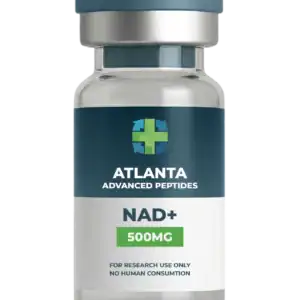
NAD+ 500mg
-
Unit Size: 500mg
-
Form: Lyophilized powder
-
Molecular Weight: 663.43 g/mol
-
Storage: Store in a cool, dry place. Once reconstituted, maintain between 2°C–8°C and use within 10–14 days under sterile conditions.
$69.99
Description
What is NAD+?
NAD+ — Nicotinamide Adenine Dinucleotide — is worth introducing carefully because it is different from every other product in this catalog in one important respect: it is not a peptide. It is a dinucleotide coenzyme — a small, non-protein molecule composed of two nucleotides joined through their phosphate groups, derived from niacin (vitamin B3) — and it is present in every living cell on earth. That ubiquity is not incidental. NAD+ is arguably the most central molecule in cellular energy metabolism, functioning as the primary electron carrier in redox reactions that generate ATP across glycolysis, the citric acid cycle, and oxidative phosphorylation. Without it, cellular energy production stops entirely.
The reason NAD+ 500mg research compound has become such an active area of laboratory investigation is not because researchers recently discovered NAD+ — it has been studied since the early 1900s. It is because research over the past two decades revealed something unexpected: NAD+ levels decline substantially with age in measurable, consistent patterns across species, and that decline appears to correlate with a broad range of age-associated changes in cellular function. That finding transformed NAD+ from a well-understood metabolic molecule into one of the most intensively studied compounds in longevity biology, mitochondrial research, and cellular ageing investigation. Atlanta Advanced Peptides supplies NAD+ 500mg exclusively for in-vitro and in-vivo scientific research use only — not for human or veterinary use.
NAD+ 500mg Compound Specifications
| Specification | Detail |
|---|---|
| Common Name | NAD+ / β-NAD+ |
| Full Name | β-Nicotinamide Adenine Dinucleotide (oxidised form) |
| Synonyms | β-NAD, DPN, Coenzyme I |
| Chemical Formula | C₂₁H₂₇N₇O₁₄P₂ |
| Molecular Weight | 663.43 g/mol |
| CAS Number | 53-84-9 |
| Format | 500mg lyophilized powder |
| Purity | ≥ 99% |
| Appearance | White to off-white lyophilized powder |
| Solubility | Fully soluble in water |
| Storage | Store at -20°C, away from light and moisture |
| Reconstitution | Sterile or bacteriostatic water recommended |
| Research Use | In-vitro and in-vivo laboratory research only |
The NAD+ Decline Discovery — Why This Molecule Became a Research Priority
Understanding why nicotinamide adenine dinucleotide research has exploded over the past decade requires knowing what changed in how scientists think about NAD+. For most of the 20th century, NAD+ was studied primarily as a metabolic coenzyme — important, well-characterised, and not particularly mysterious. What shifted the research landscape was a series of studies in the 2000s and 2010s that documented consistent, age-associated NAD+ decline in tissue samples across multiple species, including humans.
The implications of that finding reached far beyond basic metabolism. NAD+ is also the essential substrate for two enzyme families that had independently become central to longevity and cellular repair research — sirtuins and PARPs. Sirtuins are a family of NAD+-dependent deacylases involved in gene regulation, mitochondrial function, and stress response biology. PARPs are poly(ADP-ribose) polymerases that consume NAD+ during DNA damage repair. Both enzyme families require NAD+ to function, which meant that age-associated NAD+ decline potentially compromised cellular repair capacity, stress response, and metabolic regulation simultaneously. That convergence of mechanisms is what drove the dramatic expansion of published NAD+ 500mg research compound investigation — it placed this molecule at the intersection of several of the most actively researched areas in modern biology.
NAD+ in Scientific Research
The published research literature on NAD+ spans basic biochemistry, cellular biology, mitochondrial function, neurological research, metabolic biology, and longevity science. Rather than listing every domain, the sections below cover the research areas most relevant to laboratories working with buy NAD+ 500mg compound in controlled research settings.
Sirtuin Activation and Gene Regulation Research
The sirtuin research context is where NAD+ biology intersects most directly with longevity science. Sirtuins (SIRT1-7) are a family of NAD+-dependent enzymes that regulate a remarkable breadth of cellular processes — chromatin remodelling, mitochondrial biogenesis, inflammatory pathway modulation, and cellular stress response among them. Published laboratory studies have documented that NAD+ availability directly limits sirtuin activity in cell culture and animal research models, establishing a direct mechanistic link between cellular NAD+ levels and sirtuin-regulated biological pathways. SIRT1 and SIRT3 in particular have been extensively studied in this context, with published research examining their roles in mitochondrial function, fatty acid oxidation, and oxidative stress response in controlled laboratory environments. This is the area of nicotinamide adenine dinucleotide research that has generated the most published investigation over the past decade.
DNA Repair and PARP Pathway Research
PARP enzymes consume NAD+ during the DNA damage response — catalysing the addition of poly(ADP-ribose) chains to proteins at damage sites as part of the repair signalling cascade. Published laboratory research has examined how NAD+ availability influences PARP activity and DNA repair efficiency in cell culture models, with studies investigating the NAD+/PARP interaction in contexts ranging from oxidative DNA damage to replication stress response. This area of investigation connects NAD+ biology directly to genome stability research and is one of the more mechanistically precise areas of published NAD+ literature — the substrate-enzyme relationship is well-characterised and reproducible in laboratory conditions.
Mitochondrial Function and Cellular Bioenergetics Research
NAD+’s foundational role as an electron carrier in the electron transport chain makes it central to any laboratory investigation of mitochondrial function and ATP production. Published research has examined how manipulating NAD+ levels in cell culture and animal models influences mitochondrial membrane potential, oxygen consumption rates, and ATP synthesis efficiency in controlled experimental environments. This area of investigation connects directly to research on the MOTS-c compound also available in our catalog — published studies have examined NAD+ and MOTS-c in overlapping mitochondrial biology contexts, with both compounds influencing AMPK pathway activation and cellular energy homeostasis in laboratory research models.
Neurological and Neuroprotective Research Models
A substantial body of published laboratory research has investigated NAD+ in neurological research contexts. In-vitro studies have examined how NAD+ levels influence neuronal survival under oxidative stress conditions, with published research documenting NAD+’s interaction with neuroprotective signalling pathways and its role as a substrate for neuronal PARP and sirtuin activity in brain tissue research models. Published in-vivo studies have examined NAD+ in neurodegeneration research contexts, with animal model investigations exploring its interaction with dopaminergic pathway biology, mitochondrial function in neural tissue, and inflammatory signalling in CNS research environments. Researchers working with Semax or other neurological research compounds will find NAD+ referenced in overlapping published literature on neuronal energy metabolism and neuroprotective pathway biology.
Metabolic Biology and Insulin Sensitivity Research
The connection between NAD+ and metabolic biology extends beyond energy production into insulin signalling and glucose metabolism research. Published laboratory studies have examined how NAD+ availability influences SIRT1-mediated regulation of insulin sensitivity in muscle and adipose tissue cell models, with research documenting downstream effects on GLUT4 expression, glucose uptake signalling, and lipid metabolism pathway regulation in controlled experimental environments. This area of the NAD+ 500mg research compound literature connects directly to the broader field of metabolic biology investigation and overlaps with research contexts relevant to GLP-1 and metabolic pathway compounds.
Cellular Ageing and Senescence Research
Cellular senescence — the process by which cells permanently exit the cell cycle in response to stress or damage — has become a major research focus in ageing biology, and NAD+ is deeply embedded in this literature. Published laboratory studies have examined how declining NAD+ levels influence the transition to cellular senescence, with research investigating NAD+’s role in SIRT1-mediated suppression of senescence-associated secretory phenotype (SASP) pathway activation in cell culture models. This represents one of the most actively expanding areas of NAD+ research publication and one where the mechanistic connections between NAD+ biology, sirtuin activity, and cellular ageing pathways are being most actively explored in controlled laboratory settings.
Research Disclaimer: All research references above relate exclusively to published scientific literature and controlled laboratory investigations. NAD+ 500mg supplied by Atlanta Advanced Peptides is for research use only and is not approved for human or veterinary application under any circumstances.
A Note on NAD+ vs NMN and NR in Research Contexts
Researchers new to this area occasionally ask how NAD+ as a direct research compound relates to NMN (Nicotinamide Mononucleotide) and NR (Nicotinamide Riboside) — the NAD+ precursor compounds that have attracted significant parallel research attention. The honest answer is that they serve different research purposes. NMN and NR are NAD+ biosynthesis precursors — they are converted to NAD+ intracellularly through the salvage pathway. Direct NAD+ allows laboratory researchers to study the coenzyme’s effects without the additional variable of cellular precursor conversion efficiency, which can differ significantly across cell types and experimental conditions. For protocols where intracellular NAD+ concentration needs to be controlled or elevated directly rather than through precursor supplementation, the direct compound is the appropriate research tool.
Ordering NAD+ 500mg
To buy NAD+ 500mg from Atlanta Advanced Peptides, add the compound to your cart and complete checkout through our secure encrypted payment gateway. Orders are processed Monday through Friday during standard business hours. All orders ship via USPS Ground Advantage or USPS Priority Mail with full tracking provided by email.
All purchases are made with the explicit understanding that:
- The purchaser is 18 years of age or older
- The compound will be used solely for legitimate in-vitro or in-vivo laboratory research
- The product will not be used for human or veterinary purposes under any circumstances
Reconstitution Guidelines for Research Use
NAD+ 500mg is supplied as a lyophilized powder and is fully soluble in water. It is compatible with both sterile water and bacteriostatic water as reconstitution solvents. NAD+ in solution is sensitive to light and temperature — store reconstituted compound refrigerated at 2–8°C, protected from light, and use within your research protocol timeframes. Apply standard laboratory PPE and sterile technique throughout all handling steps.
Related Research Compounds
Researchers working with NAD+ frequently reference these related compounds in their laboratory studies:
- MOTS-c 10mg — mitochondrially-derived peptide with overlapping AMPK and cellular energy pathway research contexts, frequently referenced alongside NAD+ in mitochondrial biology and metabolic regulation investigation
- Tesamorelin 10mg — GHRH analog studied in metabolic and body composition research contexts that intersect with NAD+ biology investigation
- Semax — neuropeptide analog referenced in neurological and neuroprotective research contexts alongside NAD+ in CNS biology investigation
- GLP-1 SM 10mg — GLP-1 receptor agonist studied in metabolic signalling research domains that overlap with NAD+ sirtuin and insulin sensitivity investigation
- Bacteriostatic Water 10ml — recommended reconstitution solvent for laboratory use
Research Disclaimer
⚠️ For Laboratory Research Use Only
NAD+ 500mg supplied by Atlanta Advanced Peptides is intended strictly for in-vitro and in-vivo scientific research conducted by qualified researchers in controlled laboratory environments. This compound is not approved for human consumption, veterinary use, or any clinical application whatsoever. It is not classified as a drug, supplement, food product, or therapeutic agent. All purchasers must be 18 years of age or older. By completing a purchase, the buyer explicitly confirms that this compound will be used solely for legitimate scientific research purposes and in full compliance with all applicable local, state, and federal laws and regulations.
Additional information
| Weight | 0.2 lbs |
|---|---|
| Unit Size | 500mg |
| Molecular Weight | 663.43 g/mol |
| Form | Lyophilized powder |
you may also like...
- Research use only