- Research-Grade Peptides · 18+ Only · For Laboratory Use Only

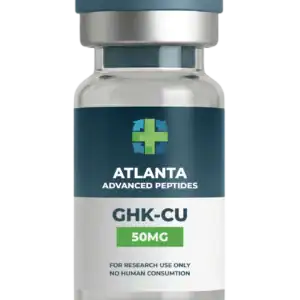
GHK-Cu 50mg Copper Peptide Complex
-
Unit Size: 50mg (lyophilized powder)
-
Sequence: Gly-His-Lys
-
Molecular Weight: ~340.88 Da
-
Storage: Store dry at 2°C–8°C. After reconstitution, refrigerate (2°C–8°C).
$42.50 – $57.50Price range: $42.50 through $57.50
Description
What is GHK-Cu?
GHK-Cu is a naturally occurring copper-binding tripeptide — Glycine-Histidine-Lysine complexed with a copper ion — that has been the subject of scientific research since the early 1970s. It was first isolated from human plasma by Dr. Loren Pickart, who observed that older human plasma lost its ability to support liver cell function that younger plasma maintained, and traced that difference back to this small tripeptide. That discovery opened five decades of laboratory investigation that has made GHK-Cu one of the most extensively studied copper peptide complex compounds in biological research.
What makes GHK-Cu genuinely interesting from a research standpoint is its unusual breadth. Most peptide compounds attract research attention in one or two biological domains. GHK-Cu has been investigated across wound biology, collagen synthesis, antioxidant signaling, gene expression, neurological research, and anti-inflammatory pathway models — a cross-disciplinary research profile that is rare for a tripeptide of this size. Atlanta Advanced Peptides supplies GHK-Cu 50mg research compound exclusively for qualified laboratory researchers in the USA, strictly for in-vitro and in-vivo scientific research use only.
GHK-Cu 50mg Compound Specifications
| Specification | Detail |
|---|---|
| Common Name | GHK-Cu |
| Full Name | Copper Peptide Complex (Gly-His-Lys-Cu²⁺) |
| Sequence | Gly-His-Lys |
| Molecular Formula | C₁₄H₂₄CuN₆O₄ |
| Molecular Weight | 403.9 g/mol |
| Format | 50mg lyophilized powder |
| Purity | ≥ 99% |
| CAS Number | 49557-75-7 |
| Storage | Store at -20°C, away from light and moisture |
| Reconstitution | Bacteriostatic water or sterile water recommended |
| Research Use | In-vitro and in-vivo laboratory research only |
GHK-Cu in Scientific Research — A Deeper Look
Few peptide compounds have accumulated as diverse a published research record as GHK-Cu. To researchers encountering it for the first time, the breadth of published studies can seem surprising for something as small as a tripeptide. Understanding why requires looking at what copper does biologically and why a copper-binding peptide that the human body naturally produces at declining concentrations with age became such a compelling research subject across so many disciplines.
Copper is an essential trace element involved in dozens of enzymatic processes — from superoxide dismutase activity to collagen crosslinking to mitochondrial electron transport. GHK-Cu’s ability to bind and transport copper ions in laboratory models has led researchers to study it across virtually every biological domain where copper plays a role. The following sections cover the primary areas of published investigation.
Skin Biology and Collagen Synthesis Research
Skin biology is where the GHK-Cu research literature is deepest. Published laboratory studies have examined how the copper peptide complex interacts with fibroblast activity in in-vitro cell culture models, with documented effects on collagen and elastin synthesis signaling, glycosaminoglycan production, and dermal extracellular matrix remodeling pathways. Research groups have also investigated GHK-Cu’s interaction with matrix metalloproteinase regulation — enzymes responsible for breaking down extracellular matrix components — in controlled laboratory environments. This area of investigation has generated a substantial and consistently cited body of peer-reviewed literature spanning decades.
Wound Biology and Tissue Remodeling Models
GHK-Cu’s involvement in wound biology research predates most of the other peptide compounds in our catalog. Published studies going back to the 1980s and 1990s documented its interaction with wound contraction signaling, angiogenesis models in wound healing contexts, and keratinocyte migration in controlled laboratory environments. More recent investigations have continued to expand this area of research, examining GHK-Cu’s influence on growth factor signaling pathways — including TGF-β and FGF — in laboratory wound biology models. Researchers studying tissue remodeling often study GHK-Cu alongside compounds like BPC-157, which covers overlapping but distinct biological pathways in published literature.
Antioxidant and Oxidative Stress Research
One of the more consistently documented findings in GHK-Cu laboratory research is its interaction with antioxidant enzyme systems. Published in-vitro studies have examined how buy GHK-Cu copper peptide research compound models influence superoxide dismutase expression, catalase activity, and reactive oxygen species modulation in cell culture environments. The copper-binding nature of GHK-Cu is central to this research context — copper is a cofactor in several key antioxidant enzymes, and GHK-Cu’s ability to deliver copper in laboratory models has made it a relevant research tool for studying oxidative stress biology.
Gene Expression Research — The Most Surprising Finding
Perhaps the most unexpected area of GHK-Cu research — and the one that has generated significant recent scientific interest — involves gene expression profiling. A landmark laboratory study published by Dr. Pickart and colleagues identified that GHK-Cu influenced the expression of over 4,000 human genes in controlled in-vitro conditions, with roughly a third showing upregulation and two thirds showing downregulation across pathways linked to inflammation, tissue remodeling, DNA repair, and cellular metabolism. This finding gave GHK-Cu research a new dimension that extends well beyond its original skin biology focus, and it continues to drive published investigation into the compound’s gene regulatory interactions in laboratory models.
Neurological and Neuroprotective Research Models
A smaller but growing body of published literature has investigated GHK-Cu 50mg research compound analogs in neurological research contexts. In-vitro studies have examined GHK-Cu’s interaction with nerve growth factor signaling, neuroprotective pathway models, and neuroinflammation biology in controlled laboratory environments. Copper’s essential role in neurological function — and its involvement in several neurodegenerative disease models — has made copper peptide compounds increasingly relevant to researchers working in CNS biology.
Research Disclaimer: All research references above relate exclusively to published scientific literature and controlled laboratory investigations. GHK-Cu supplied by Atlanta Advanced Peptides is for research use only and is not approved for human or veterinary application under any circumstances.
GHK-Cu as a Standalone vs. Inside a Blend
GHK-Cu appears as a component in several of our multi-compound research blends — including KLOW 80mg and Wolverine 70mg. Researchers deciding whether to use this standalone 50mg vial or one of those blends should base that decision on their protocol requirements.
If your study is specifically investigating GHK-Cu’s isolated effects — whether in gene expression profiling, collagen signaling, or antioxidant pathway models — the standalone 50mg vial gives you a clean experimental environment without other compounds introducing variables. If your research design intentionally studies compound interactions or covers multiple overlapping biological pathways simultaneously, the blends are the more practical choice. Both options are supplied at ≥99% purity.
Ordering GHK-Cu 50mg
GHK-Cu 50mg ships via USPS Ground Advantage or USPS Priority Mail to research facilities across the USA. Orders are processed Monday through Friday and full tracking is provided with every shipment. Checkout is fully encrypted.
All purchases are made with the explicit understanding that:
- The purchaser is 18 years of age or older
- The compound will be used solely for legitimate in-vitro or in-vivo laboratory research
- The product will not be used for human or veterinary purposes under any circumstances
Reconstitution Guidelines for Research Use
GHK-Cu 50mg is supplied as a lyophilized powder. It is compatible with both bacteriostatic water and sterile water as reconstitution solvents. Inject solvent slowly down the inner wall of the vial without shaking vigorously. Store reconstituted compound refrigerated at 2–8°C and use within your research protocol timeframes. Standard laboratory PPE and sterile technique should be applied throughout.
Related Research Compounds
Researchers working with GHK-Cu 50mg frequently reference these related compounds in their laboratory studies:
- BPC-157 — frequently studied alongside GHK-Cu in wound biology and tissue remodeling research models, covering overlapping but distinct pathway mechanisms
- TB-500 (Thymosin Beta-4) — actin-binding peptide studied in connective tissue and cellular migration research contexts alongside GHK-Cu
- Wolverine 70mg — multi-compound research blend containing GHK-Cu, BPC-157, and TB-500 in a single vial
- KLOW 80mg — four-compound blend containing GHK-Cu, BPC-157, TB-500, and KPV for multi-pathway research protocols
- Bacteriostatic Water 10ml — recommended reconstitution solvent for laboratory use
Research Disclaimer
⚠️ For Laboratory Research Use Only
GHK-Cu 50mg supplied by Atlanta Advanced Peptides is intended strictly for in-vitro and in-vivo scientific research conducted by qualified researchers in controlled laboratory environments. This compound is not approved for human consumption, veterinary use, or any clinical application whatsoever. It is not classified as a drug, supplement, food product, or therapeutic agent. All purchasers must be 18 years of age or older. By completing a purchase, the buyer explicitly confirms that this compound will be used solely for legitimate scientific research purposes and in full compliance with all applicable local, state, and federal laws and regulations.
Additional information
| Weight | 0.2 lbs |
|---|---|
| Unit Size | 50mg, 100mg |
| Sequence | Gly-His-Lys |
| Form | Lyophilized powder |
you may also like...